
If you’ve been in the 340B world long enough, you know the only constant is that manufacturers will keep trying to move the goalposts. But the latest shift: moving from upfront discounts to a post-sale rebate model: isn't just a goalpost move. It’s an attempt to change the entire game, and your cash flow is the ball.
As we look toward the 2026 landscape, the 340B rebate model is no longer a distant "what if." Despite the recent temporary pause and the ongoing HRSA Request for Information (RFI), the writing is on the wall. Manufacturers like Johnson & Johnson (J&J) and Bristol Myers Squibb (BMS) are pushing hard to flip the script on drugs like Eliquis, Xarelto, and Stelara.
For Federally Qualified Health Centers (FQHCs) and other covered entities, this isn't just an administrative headache. It’s a structural threat to your mission. You are essentially being asked to provide an interest-free loan to multi-billion-dollar pharmaceutical companies while you wait weeks: or months: to get your own savings back.
At GapRx 340B Consultants LLC, we’ve seen how "technical tweaks" can spiral into operational nightmares. That’s why we’ve developed a proven readiness framework to help you manage the volatility before it manages you.
The Cash Flow Shock: Quantifying the "Interest-Free Loan"
Let’s talk numbers, because that’s where the rebate model really hurts. Historically, 340B has been a "discount at the point of purchase" program. You buy a drug for $1, you dispense it, and you keep the spread. Your cash flow is protected because your acquisition cost is low from day one.
Under the rebate model, you buy that same drug at Wholesale Acquisition Cost (WAC): full price. Then, you submit data, jump through compliance hoops, and hope the manufacturer sends you a check for the difference 45 to 120 days later.
The financial impact is staggering. Industry analysis shows that even a small FQHC might need an additional $23,000 to $51,000 in cash on hand per month just to finance the purchase of pilot drugs like Eliquis and Xarelto. During the transition, your spend on affected drugs could spike by 500% to 5,000% overnight.
For many health centers, this extra working capital requirement equals 79% to 144% of their total monthly 340B savings for those drugs. In plain English: all the savings you use to fund sliding-fee scales and patient outreach will be tied up in a manufacturer’s bank account instead of yours.
The Proven Framework for Rebate Readiness
Survival in this new era requires moving past manual spreadsheets and "hope-based" compliance. You need a methodical, tech-driven approach.
1. Stress-Testing & Financial Modeling
Don’t wait for the mandate to find out you’re underwater. Your first step must be a deep-dive financial model of your "WAC-upfront" scenario.
You need to identify every NDC-11 in your formulary that falls under the proposed pilot (like those from J&J and BMS) and calculate the delta between 340B and WAC pricing.
- What is your "Days Cash on Hand" impact?
- Can your current credit line handle a 10x increase in specialty drug spend?
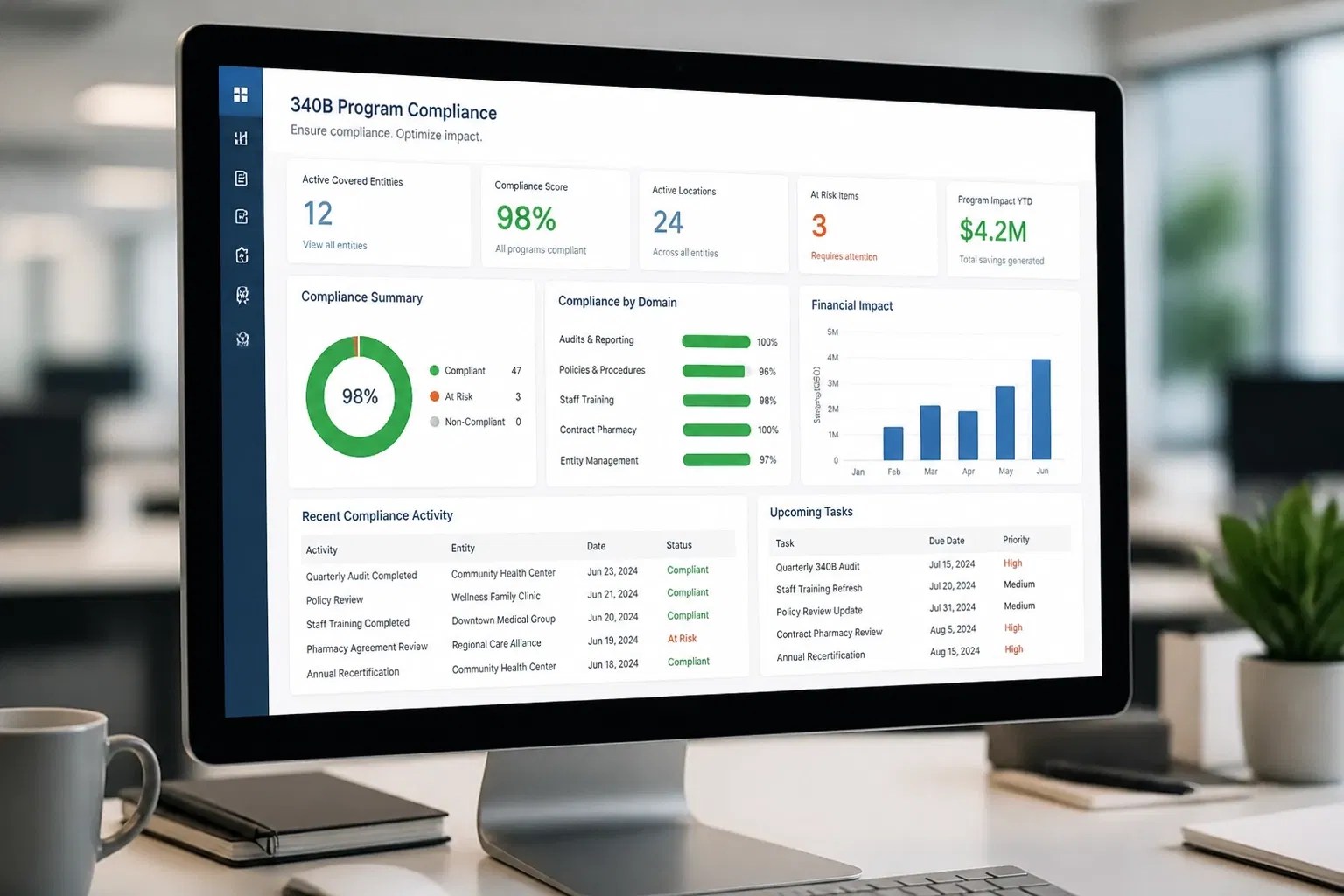
Modeling these scenarios now allows you to approach your board with data-backed requests for working capital adjustments before the crisis hits. Our Advanced Analytics platform is designed specifically to give you this level of visibility.
2. Establish a Cross-Functional Command
The rebate model is too big for the Pharmacy Director to handle alone. This is a finance problem, a data problem, and a compliance problem. You need a "Rebate Readiness Team" that includes:
- Finance: To manage the working capital shift and track accounts receivable (AR) for rebates.
- Pharmacy/IT: To ensure data feeds are capturing every required field (NDC, Prescriber ID, 340B ID).
- Compliance: To ensure you aren't accidentally triggering duplicate discounts with Medicaid rebates: a major focus of the HRSA RFI.
3. Automated Claims Consolidation (The End of Manual 340B ESP)
If you are still manually uploading files to 340B ESP, you are already behind. Under a rebate model, a single missing data point or a late submission doesn't just mean a warning; it means a permanent loss of revenue.
Manufacturers are looking for any reason to deny a rebate claim. If your data is messy, they win. You need fully automated Manufacturer Compliance & 340B ESP Management that ensures claims-level data is submitted accurately and on time, every time.
4. Real-Time Validation: Tracking the Life of a Claim
In the old world, you looked back at the end of the month to see how you did. In the rebate world, that’s too late. You need to track every claim from the moment of purchase to the moment the rebate hits your bank account.
This requires a "Rebate Ledger" approach. You should know exactly:
- Which claims are pending manufacturer approval.
- Which claims have been denied (and why).
- The average "lag time" between dispense and payment.
Without real-time validation, your "Rebate Receivable" account becomes a black hole on your balance sheet.

Why Compliance is Now a Cash Flow Strategy
For years, compliance was about avoiding HRSA findings. It was a defensive play. Now, compliance is your primary offensive strategy for cash flow survival.
Every "denied" rebate claim is a direct hit to your operating margin. If a manufacturer rejects a claim for Eliquis because of a missing Prescriber ID, you just paid WAC for a 340B drug. That’s a mistake an FQHC cannot afford to make at scale.
This is why our HRSA Audit & 340B Compliance frameworks are now being integrated directly with our rebate validation tools. You cannot have one without the other. If your data isn't audit-ready, it isn't "rebate-ready."
Navigating the 2026 Landscape with GapRx
The transition to a 340B rebate model is intentionally complex. Manufacturers are betting that the administrative burden will cause enough "leakage" to save them billions. We’re here to make sure they lose that bet.
At GapRx 340B Consultants LLC, we specialize in helping covered entities navigate these exact shifts. Whether it’s optimizing your In-House Pharmacy to capture more margin or providing the Rebate Consolidation tech needed to manage the 2026 pilot, our team acts as an extension of your own.
Don't let manufacturer tactics jeopardize your ability to serve your community. The framework for readiness exists: it’s just a matter of implementation.

Ready to stress-test your program for the rebate model?
Schedule a consultation with GapRx today and let’s turn your cash flow volatility into a managed, compliant strategy.